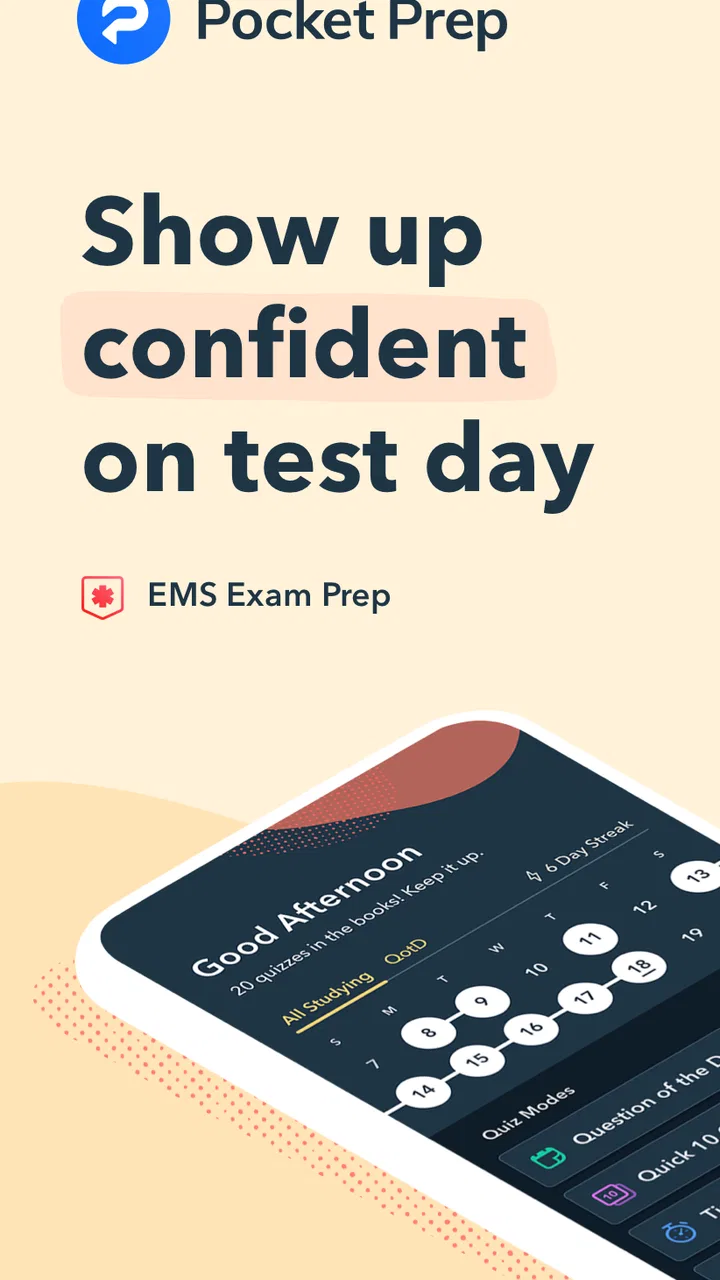
Pocket Prep EMS 2026
- 4.5
- Rating
- 100.00K
- Installs
- Free
- Price
 Analysis by App-foxy
Preparing for an EMS exam is less about finding one impressive study session and more about building a routine you can keep when work, classes, and real-life responsibilities get in the way. I found Pocket Prep EMS 2026 most useful in that role: it turns spare minutes into focused practice and gives EMS learners a large question bank to work through without requiring a full textbook session every time. It is an Education app from Pocket Prep, Inc., available free with optional in-app purchases ranging from $15.99 to $95.99 per item.
The app is aimed at people preparing for nine EMS exams, with more than 9,000 practice questions and mock exams available within its study system. That makes it much more specialized than a general flashcard app. I would not treat it as a replacement for classroom instruction, hands-on training, or official exam guidance, but I can see why it has become a practical companion for learners who need repeated question practice.
Its public reception is encouraging without being a reason to stop evaluating it critically. It holds a 4.5 average from around 2.8 thousand ratings, has over 100 thousand installs, and carries an Everyone age rating. The app was released on February 4, 2021, and the current version is 3.29.1, with Android support beginning at version 8.0. Those details make it accessible to many users, although compatibility still depends on the device and operating system you use.
You May Also Like

 Blood Strike: 2.5 Anniversary
Blood Strike’s Loadouts Turn Every Drop Into a Tactical Gamble
A close look at Blood Strike’s custom loadouts: how fast access to signature weapons reshapes its battle royale rhythm, rewards preparation, and narrows the gap between fights.

 Pandora - Music & Podcasts
Pandora’s Music Is Easy to Start, but Harder to Recover
Pandora’s strength is its low-effort path from a seed to a station. Its weak spot is how much confidence it asks you to place in connection, setup, and quiet recovery.

 8 Ball Pool
 Is Built on Rivalries, Rematches, and Routine
A close look at the rivalries, rematches, shared routines, and unanswered safety questions that turn a quick pool match into a persistent mobile community.

 Samsung Music
’s Quiet Strength Is Playing What You Already Own
Its reach comes less from spectacle than from dependable access to a personal library. That simplicity is both the app’s strongest retention engine and its ceiling.

 AccuWeather: Weather Radar
AccuWeather Review: A Quick, Clear Forecast for Everyday Decisions
For everyday plans, the best forecast is the one you can understand quickly. AccuWeather makes rain timing, radar, and local conditions easy to act on, with a few trade-offs.

 Hill Climb Racing
Why Hill Climb Racing Still Turns Crashes Into One More Run
A tiny car, a bumpy hill and one more upgrade: Hill Climb Racing keeps resurfacing because its simple chaos makes every near-miss feel personal.
More From Our News Desk



What makes the study approach practical
I use this section to look beyond the question count and focus on the habits that make practice useful: choosing a manageable session, noticing where uncertainty keeps returning, and taking those gaps back to course materials. The aim is to make each visit purposeful rather than simply completing more questions. From there, it makes sense to consider which settings and choices deserve attention before settling into a routine.
Short practice sessions fit real EMS schedules
The strongest part of this app is its fit with fragmented study time. An EMS student may have ten minutes before class, a break during a shift, or a tired evening when reading a long chapter feels unrealistic. A question-based app gives each of those moments a clear purpose. I can open a session, answer a manageable group of questions, and leave with a better idea of which topics deserve attention next.
That convenience matters because passive reading can create a false sense of familiarity. When I answer a question without looking at the explanation first, I have to commit to a choice. That exposes uncertainty much faster than highlighting a paragraph in a manual. The app is therefore most valuable when I use it as an active recall tool rather than as background content.
I also like the possibility of using different session lengths according to the day. A short run works well for maintenance, while a longer practice block can simulate the concentration required during exam preparation. The important habit is not simply opening the app often; it is reviewing mistakes after answering. Without that second step, a large question bank can become a race for completion instead of a learning process.
Question volume is useful only with a deliberate workflow
A bank of more than 9,000 questions sounds generous, but volume alone does not guarantee progress. My preferred workflow would be to begin with mixed practice, note recurring weak areas, and then return to targeted review. If I repeatedly miss questions involving the same subject, I would stop treating each mistake as an isolated event and use it as a signal to revisit the underlying concept in class notes or a trusted textbook.
This is one of the less obvious trade-offs. A broad question bank can reveal patterns that a small quiz collection hides, but it can also encourage superficial repetition. I would avoid answering hundreds of questions while barely reading the explanations. Ten carefully reviewed questions can teach more than a much larger number completed on autopilot.
Mock exams are particularly useful later in the process, when I want to test stamina and decision-making under pressure. They are less useful as the first step if I have not yet built a foundation. Early in preparation, I would favor focused practice and explanation review. Near the exam, I would use mock sessions to discover whether fatigue, pacing, or second-guessing is affecting my performance.
Who will get the most from it
This app makes the most sense for EMS students, candidates returning to study after a long break, and working learners who need a portable way to keep concepts active. It can also help someone who already owns study materials but struggles to turn them into a consistent routine. In that situation, the app supplies structure while the textbook or course provides fuller teaching.
I would be more cautious about recommending it as a person’s only preparation resource. Someone completely new to EMS may need guided instruction, demonstrations, instructor feedback, and context that practice questions cannot provide by themselves. A question can show that an answer is wrong, but it may not replace the deeper explanation needed to understand assessment priorities or clinical reasoning.
It is also not the ideal choice for a learner who dislikes multiple-choice practice or who needs extensive visual, audio, or hands-on teaching. The app’s value depends on your willingness to answer, reflect, and connect each result to broader study. If you want a complete course delivered from beginning to end, a formal program or instructor-led resource will probably be a better foundation.
A realistic everyday use case
Imagine an EMT student who works an afternoon shift and has an exam approaching. Before work, the student completes a short practice session and marks the questions that required guessing. During a break, they review those explanations rather than starting another random set. That evening, they consult class material for the two topics that appeared repeatedly in the mistakes. The next day, they try a fresh set to see whether the same errors return.
That routine shows where Pocket Prep EMS 2026 fits best. It is not doing all the teaching, but it is making weak points visible and giving the student a repeatable way to check improvement. The app becomes more useful when it is connected to a study plan instead of being used as an isolated quiz game.
How it compares with common alternatives
Compared with paper flashcards, this app is more convenient for changing practice sets and working through a large collection in a limited amount of time. Flashcards can still be better for memorizing personally selected facts, especially when a student wants complete control over wording. I would use physical or self-made cards for highly specific class notes and the app for broader exam-style practice.
Compared with a textbook, the app is faster to open and better suited to testing recall. A textbook remains stronger when I need a connected explanation, diagrams, or a slow review of a difficult subject. The two formats complement one another rather than competing directly.
Compared with a general quiz platform, the advantage here is the EMS focus and the connection to nine exam paths. A broad study app may offer more flexibility across subjects, but that flexibility can also create noise. If your goal is EMS exam preparation, a specialized bank is more efficient than building a study system from unrelated medical quizzes.
The main comparison point is cost. The app is free to download, which makes it easy to try before committing, but optional purchases can become significant depending on the item selected. I would first test whether the question style, explanations, and available study flow suit me. Only then would I consider paying for expanded access, and I would compare that expense with the price of the other resources already in my study plan.
Trust begins with clear expectations
For an education app connected to professional exam preparation, trust is not only about the number of questions. I want to know what I am using, who develops it, what it costs, and how much control I have before I invest time or money. The listing identifies Pocket Prep, Inc. as the developer, presents the app as free, and clearly indicates that optional purchases are available. That gives me a straightforward starting point rather than making the payment model invisible.
The Everyone rating also makes the app broadly approachable from an age-classification perspective. That does not tell me whether the material is suitable for every learner’s academic level, but it does make the app feel appropriate for general educational use rather than restricted entertainment content.
I would still keep my expectations realistic. A store rating of 4.5 from around 2.8 thousand ratings suggests that many users find value in it, but ratings cannot prove that every question matches a particular exam blueprint or that the app will suit every learning style. I would use the app alongside current course requirements and official exam information, especially if my exam path has recently changed.
Controls, purchases, and personal responsibility
The most important visible choice is whether to remain with the free experience or purchase additional content. Since individual in-app purchases range from $15.99 to $95.99, I would pay close attention to the purchase screen before confirming anything. The practical question is not simply whether the largest option offers more material; it is whether that material supports my specific exam and whether I will use it consistently.
I would also avoid buying access just because a large question count feels reassuring. More content is valuable only when I have enough time to review it properly. A smaller, well-used portion may be more beneficial than an expensive option that leaves me overwhelmed. This is especially important for students balancing employment, clinical practice, and coursework.
Account and purchase decisions deserve the same care as study decisions. I would use the platform’s visible account controls, review any subscription or purchase wording carefully, and keep track of which access level I selected. I would not assume that installing the free app automatically means every feature is included, nor would I treat a paid option as a guarantee of exam success.
Handling study content and personal data thoughtfully
Any app used for education creates moments where I should pause before entering information. I would avoid putting patient details, workplace incidents, private instructor comments, or identifiable clinical stories into any notes or account fields unless I had a clear reason and permission to do so. Exam preparation does not require exposing someone else’s confidential information.
I would also review the app’s visible privacy and account choices before creating or updating an account. The sensible approach is to provide only what is needed for access and support, keep login details secure, and remove old information through the available controls if I stop using the service. These are ordinary habits, but they matter more when study activity is connected to a personal profile or purchase history.
On a shared phone or tablet, I would pay attention to account switching and saved payment details. A study app may be harmless in itself, yet an unattended device can expose progress information or allow an accidental purchase. Locking the device and checking the active account before purchasing are small steps that prevent avoidable problems.
Where the app can create friction
The first limitation is that practice questions can become repetitive if I use them without a broader plan. Repetition is useful for recall, but EMS preparation also requires understanding why an action is appropriate, how priorities change, and how knowledge applies in context. I would not want a correct answer to become a substitute for explaining the reasoning in my own words.
The second limitation is financial uncertainty for heavy users. Free access lowers the barrier to trying the app, but the in-app purchase range means the full experience may not fit every student’s budget. Before paying, I would compare the available option with a school-provided question bank, library resource, or existing review book. The best value depends on how much of the content I will realistically complete.
The third is device dependence. Because the app requires Android 8.0 or later, someone using an older phone may need to update or use another device. Even on a compatible phone, I would not rely on a mobile app as my only study location if I know I concentrate better with printed notes or a larger screen.
Finally, the current version, 3.29.1, is useful context but not a promise that every learner will see the same experience forever. I would keep the app updated when appropriate and check its current content against the requirements of my particular exam. Version information helps identify the software being used; it does not replace academic verification.
My verdict for serious exam preparation
The best way to use Pocket Prep EMS 2026 is as a disciplined practice companion, not as a complete EMS education. I appreciate its focused purpose, substantial question bank, mock-exam format, and suitability for short study sessions. It gives a busy learner a concrete action to take instead of waiting for a large block of free time.
I would recommend trying the free version to judge the question style and study rhythm personally. If the explanations help you identify real weaknesses and you can commit to reviewing mistakes, a paid option may be worthwhile. If you only want a comprehensive course, hands-on instruction, or a single resource that teaches every concept from the ground up, I would choose a formal course or detailed textbook first.
My cautious conclusion is positive. The app has enough specialization to be more useful than a generic quiz tool for EMS candidates, while its free entry point makes experimentation reasonable. I would protect my budget, avoid entering sensitive clinical information, check account and purchase controls carefully, and keep official exam guidance at the center of preparation. Used that way, it can turn scattered spare minutes into meaningful practice without pretending to replace the rest of the learning process.
FAQs for Pocket Prep EMS 2026
01What is Pocket Prep EMS 2026, and who is it designed for?
Pocket Prep EMS 2026 is a mobile study and practice app for people preparing for emergency medical services examinations, including learners working toward EMT or paramedic certification and professionals reviewing their knowledge. It is designed for studying on Android or iOS, offering practice questions, explanations, progress tracking, and flexible sessions that can fit around classes, work, or clinical training.
02Does Pocket Prep EMS 2026 replace an EMS course, textbook, or official exam materials?
No. Pocket Prep EMS 2026 should be used as a supplementary study tool rather than a replacement for an accredited EMS course, instructor guidance, textbooks, hands-on training, or official examination information. The app can help identify weak areas and reinforce concepts through practice, but users should always confirm current exam requirements, clinical protocols, and medical information with their training provider and the relevant official certifying organization.
03What study features are included in Pocket Prep EMS 2026?
The app typically focuses on question-based preparation, allowing users to complete practice quizzes, review answer explanations, monitor performance, and study by topic or in shorter sessions. Progress tools can make it easier to see strengths and weaknesses over time. The exact question bank, categories, analytics, and available study modes may depend on the selected EMS exam package, subscription level, and the version currently offered in the app.
04Is Pocket Prep EMS 2026 free to download, and do I need a subscription?
The application may be available to download at no initial cost, but access to its complete question bank, explanations, performance tools, or other premium features can require an in-app purchase or subscription. Pricing, trial availability, renewal terms, and included content may differ between Android and iOS or change over time. Before subscribing, review the store listing and in-app billing details carefully, especially the automatic-renewal conditions.
05Can I use Pocket Prep EMS 2026 offline, and is it suitable for last-minute exam preparation?
Pocket Prep EMS 2026 can be useful for short study sessions while commuting, during breaks, or when internet access is limited, although some functions may require an online connection. It is also helpful for final review, but relying on an app alone immediately before an exam is not recommended. A stronger approach is to use it consistently, review explanations, revisit weak subjects, and combine practice with comprehensive EMS coursework and hands-on preparation.
Pros
- Focused EMS exam questions make study sessions easy to organize.
- Practice tests help reveal weak subjects before exam day.
- Explanations clarify why each answer is correct or incorrect.
- Progress tracking makes it easier to maintain a consistent study routine.
- Short quizzes work well for studying during commutes or brief breaks.
Cons
- Full access to the question bank may require a paid subscription.
- Some users may find repeated practice questions less engaging over time.
- It requires consistent internet access for certain content and features.
- The app is designed for EMS exams
- limiting its usefulness outside that field.
- Subscription costs can be difficult to justify for occasional learners.

Pocket Prep EMS 2026
Gallery